
Thursday, 29 March 2012
a view on the Portuguese NHS
in case you want to have a view on the current situation of the NHS in Portugal through the lens of a North-American newspaper, check here


Tuesday, 13 March 2012
GNP versus GDP
The Irish case
Ireland has experienced large trade surpluses and current account deficits. The data show that the income paid by Irish residents to non-resident owners of domestic factor of production (such as capital) is often larger than the trade balance surplus. (click to enlarge)

We are told that most of the foreign direct investment to Ireland was in capital intensive industries (such as pharmaceuticals). The implication is that labour compensation (Irish residents) commands a relatively small share of the product of those industries.
GNP and GDP
There are two main concepts of aggregate measure of goods and services produced: GNP and GDP. GDP covers the goods and services produced by labor and capital located in Ireland. As long as the labor and capital are located in Ireland, the suppliers may be either Irish residents or non-residents. GNP covers the goods and services produced by labor and capital supplied by Irish residents.
Portugal is well aware of the difference between GNP and GDP as in the past its trade balance deficit was mostly entirely covered by labour income remitted by emigrants. The advantage with GDP is certainly that it is more precisely measured than GNP. However when the focus is on the availability of a Nation's resources to finance itself, GNP appears to be the relevant aggregate.
It should be now clear that when it comes to the capacity of financing its external debt, the relevant flow concept is the current account. Obviously improving the trade balance is crucial but data have to be analyzed with a grain of salt. Assume a foreign export oriented futuristic motor-vehicle plant that produces and assembles vehicles in minutes and is controlled by 2 workers.Part of the value added produced (net exports) by the plant will stay in the country (the 2 workers wage) and part will flow out (income payments) to the plant owners.

Ireland has experienced large trade surpluses and current account deficits. The data show that the income paid by Irish residents to non-resident owners of domestic factor of production (such as capital) is often larger than the trade balance surplus. (click to enlarge)

We are told that most of the foreign direct investment to Ireland was in capital intensive industries (such as pharmaceuticals). The implication is that labour compensation (Irish residents) commands a relatively small share of the product of those industries.
GNP and GDP
There are two main concepts of aggregate measure of goods and services produced: GNP and GDP. GDP covers the goods and services produced by labor and capital located in Ireland. As long as the labor and capital are located in Ireland, the suppliers may be either Irish residents or non-residents. GNP covers the goods and services produced by labor and capital supplied by Irish residents.
Portugal is well aware of the difference between GNP and GDP as in the past its trade balance deficit was mostly entirely covered by labour income remitted by emigrants. The advantage with GDP is certainly that it is more precisely measured than GNP. However when the focus is on the availability of a Nation's resources to finance itself, GNP appears to be the relevant aggregate.
It should be now clear that when it comes to the capacity of financing its external debt, the relevant flow concept is the current account. Obviously improving the trade balance is crucial but data have to be analyzed with a grain of salt. Assume a foreign export oriented futuristic motor-vehicle plant that produces and assembles vehicles in minutes and is controlled by 2 workers.Part of the value added produced (net exports) by the plant will stay in the country (the 2 workers wage) and part will flow out (income payments) to the plant owners.

Friday, 2 March 2012
The fiscal devaluation keeps coming back..
Thursday, 1 March 2012
Portugal wages and unemployment

This is not a formal analysis and estimation of a wage Phillips curve for Portugal. However the figure (click to enlarge) shows some evidence of a prima facie negative relationship between compensation inflation and the unemployment rate. And the coefficient is not reassuring (although it is probably unstable during recessions such as now). Data are from Eurostat.
Sunday, 26 February 2012
The Euro Area + Other Currencies Areas = World
A widely shared synthesis on the symptoms of the global economic crisis exists: unsustainable private and public debt, rapid losses of competitiveness and widening of macroeconomic imbalances within a framework of zero short term interest rates and highly volatile financial markets. These symptoms appear to afflict the whole "West" and are generally identified using as unit of analysis the existing currency areas. A notable exception concerns the euro area: there, the same symptoms, especially in what regards macroeconomic imbalances, are diagnosed to be present in individual countries that form the euro area, but are much less visible when considering the area as a single unit.
Although no similarly widely shared synthesis exists on the causes and remedies of these symptoms the proposed policy mix is a multi-year fiscal deleveraging plan accommodated by expansionary unconventional monetary policy and possibly nominal depreciation. (When it comes to the current economic policy debate, I have the feeling that we are watching the latest season of the old Hats versus Caps disputes.)
The last element of this policy mix has been suggested as a solution to the internal imbalances of the euro area: let the euro devaluate and the current account deficit euro countries will readjust by expanding exports in the other currencies areas. I find this view problematic for two reasons. First, it is a currency area membership obligation to accept that internal exchange rates are irrevocably canceled and that the value of the currency changes in the same proportion for each member. Second, as mentioned above, the euro appears to be the only balanced currency area in the World.
Scale 1:1
The second column of the Table (click to enlarge) reports the accumulated current account of the 4 major world currency areas and of oil/gas exporters.

The data show the familiar imbalance between the US and the RoW together with the high government debt of the developed economies. To close this imbalance savings will need to decrease in the ROW and increase in the US, which in turn will require an adjustment of the real exchange rate between the US and the ROW. Notice that the Euro area is much more balanced when it comes to its external position: the Euro area does not participate to the global imbalances. A euro depreciation against the other major currencies would help to improve the external positions of all the euro countries but only if the depreciation increases the euro area trade surplus against the other currency areas. The Euro area is too large and important to act as if it was exogenous to the other currencies areas and must address its internal imbalances in a manner consistent with the adjustment of the global imbalances. The reward for success is likely to be large.
Although no similarly widely shared synthesis exists on the causes and remedies of these symptoms the proposed policy mix is a multi-year fiscal deleveraging plan accommodated by expansionary unconventional monetary policy and possibly nominal depreciation. (When it comes to the current economic policy debate, I have the feeling that we are watching the latest season of the old Hats versus Caps disputes.)
The last element of this policy mix has been suggested as a solution to the internal imbalances of the euro area: let the euro devaluate and the current account deficit euro countries will readjust by expanding exports in the other currencies areas. I find this view problematic for two reasons. First, it is a currency area membership obligation to accept that internal exchange rates are irrevocably canceled and that the value of the currency changes in the same proportion for each member. Second, as mentioned above, the euro appears to be the only balanced currency area in the World.
Scale 1:1
The second column of the Table (click to enlarge) reports the accumulated current account of the 4 major world currency areas and of oil/gas exporters.

The data show the familiar imbalance between the US and the RoW together with the high government debt of the developed economies. To close this imbalance savings will need to decrease in the ROW and increase in the US, which in turn will require an adjustment of the real exchange rate between the US and the ROW. Notice that the Euro area is much more balanced when it comes to its external position: the Euro area does not participate to the global imbalances. A euro depreciation against the other major currencies would help to improve the external positions of all the euro countries but only if the depreciation increases the euro area trade surplus against the other currency areas. The Euro area is too large and important to act as if it was exogenous to the other currencies areas and must address its internal imbalances in a manner consistent with the adjustment of the global imbalances. The reward for success is likely to be large.
Monday, 20 February 2012
Further austerity and wage cuts will worsen the euro crisis
This note argues that the solutions to the euro-area crisis proposed by the EU governing institutions in cooperation with the IMF, based on further austerity and wage cuts, will worsen the crisis. They are unlikely to reduce both sovereign and external debt ratios of countries experiencing these problems. Quite in contrary, they are likely to further reduce the real GDP growth of these countries.
This note is joint with Corrado Andini and is available here.
Thursday, 16 February 2012
German Professors Unite!
The German Constitutional Court recently provided an opportunity for comic relief, perhaps as a prelude to Carnival. On Tuesday it ruled out as unconstitutional the current pay scales of academics in Germany. According to the ruling of the professors-filled court, base salaries for academics are "evidently insufficient.” At the moment academic pay scales have two components: a base salary and performance bonuses, dependent on publications and the ability to attract outside funding from research councils. However, the judges in Karlsruhe determined that the fixed base salary rates were not enough for a professor, "according to his rank, to allow for the responsibility associated with his office and the meaning of the Civil Service for the general public a decent living."
So what are German professors paid? According to the German Association of University Professors, base pay for starting academics varies between €3526 per month, in Berlin, and €3926 in the state of Baden-Württemberg. Even though about 95% of professors receive bonuses, the Constitutional Court considered that these did not compensate for the excessively low base salaries since bonuses were not a ‘right’ but only a possibility. Where have we heard this before? In a very politically incorrect comparison they even noted that lawmakers were paid adequate base salaries without the need for bonuses!
On a PPP-basis, German academic salaries are today in the mid of the range of countries covered by a large survey published by the journal Nature (see figure).
In response to the ruling, the German Federal government has already called for a 25% pay rise, which will place German professors among the best paid academics in the World. The tradition of German scholarship excellence is well known, but one wonders about the consequences of the dilution of an incentive-based pay scheme for a sector whose best university ranks in the 47th place in the Academic Ranking of World Universities. After all, German judges and the government decided on an across-the-board pay rise unrelated to performance, whereas in countries such as the US and Canada, academic salaries are negotiated individually in the context of a very competitive market.
Maybe Germans are finally “loosening up” – a similar pay rise for the rest of the economy would do wonders for the competitiveness of the rest of the Eurozone.Monday, 6 February 2012
Eurobonds: a Greek tale with three lessons

The ongoing negotiations between the Greek government, the troika of official institutions, and the private creditors have failed so far to produce much, apart from increasingly inflamed rhetoric. The sitting Greek prime minister calls them a ‘moment of truth,’ while Jean-Claude Juncker, the leader of the Ecofin, delivered this weekend what amounts to an ultimatum to the Greek government.
It is perhaps fitting that yet another round of bargaining should take the tones of a Greek tragedy, but both sides seem to be dangerously over-playing their cards and run the risk of getting cornered into a position from which they may not be able to back-track. All of this brings back old memories, which are still instructive to interpret the current situation.
Greece is no newcomer to sovereign default. In fact, it spent almost half of its time as a sovereign nation in a state of default – the last one settled as recently as 1964. It is also not the first time that this country has been bailed out by its northern European partners. Greece was the beneficiary of what were probably the first two Eurobonds in history. To the proponents of this solution for the European debt crisis, the record of these two bonds offers some cautionary lessons.
After a long emancipation war, Greek independence was recognised by the Ottoman Empire in 1830. The then main European powers were instrumental to this outcome by effectively insuring Greek independence by treaty. They also funded the start up costs of the new nation with a £1.6 million loan, issued in 1833 under the several guarantee of Britain, France, and Russia. Under the agreement each power guaranteed half a million of the loan separately. Thanks to the guarantee, the new Greek nation was able to finance itself at barely 1% above the cost of borrowing for the three powers. In exchange, the powers demanded that these bonds would be senior to all previous Greek debt, raised privately to fight the independence war. This structure was remarkably similar to the Delpla-Weizsäcker proposal to divide the debt of European governments between ‘blue bonds,’ jointly guaranteed by all Eurozone nations and ‘red bonds,’ which remained the sole responsibility of each nation. In the Greek case the split was 25% blue to 75% red, adding to a massive 248% of GDP. The recent proposals for the Eurozone hark back to the debt criterion of the Maastricht treaty and propose instead a 60:40 split.
Figure 1: Greek sovereign yields, 1832

The vertical line marks the announcement of the guaranteed loan
Unfortunately, and as feared by the critics of the Eurobond proposal, one of the first consequences of the 1833 guaranteed bond was to make the remaining Greek debt unpayable. After almost a decade of war, the Greek government had no intention of pressing ahead with the tax increases needed to make good the payments on its debt. This was reflected in the yields of the old red bonds (Figure 1). After falling, in expectation of a comprehensive debt agreement, the yields rose back again to close to 20% once the details of the guaranteed bond were known. The Greek government would remain in default on its red debt until 1879! The first lesson from history is therefore that no Eurobond has a chance of success without a private sector involvement (PSI), a point only admitted since last October at German insistence, and after two failed bailout plans.
By 1839 the Greek government had also defaulted on the official blue debt, despite its supposed senior status. After a long series of efforts by the guaranteeing powers, that involved a revolution, a naval blockade, and a change of ruling dynasty, a final settlement was reached in 1864. By then the UK had paid £1.2 million of service for its share of the Greek debt, against a contribution by the Greeks of no more than £100,000. The second lesson is that just because no country ever defaulted on IMF debt that does not mean that defaults on official debt are impossible.
Thirty years and another war later, the Greek state defaulted again on a pile of debt worth 224% of GDP. The same powers intervened again and granted another guaranteed loan, issued in 1898 at the very low 2.5% interest rate. This time, however, they had learnt the lesson of moral hazard and insisted on the involvement of the private sector, which accepted a 61% cut of the original debt obligations, a value halfway between the 50% originally negotiated last October and the 70% now apparently being considered in Athens. This resulted in a drop of the total debt to 170%, split 55:45 between blue and red bonds (Figure 2). More significantly, the creditor nations forced the Greek government to limit its borrowing from the central bank and to accept the imposition of an ‘International Control Commission’ (ICC) which managed a series of domestic taxes and revenues to ensure that foreign creditors were paid before any other claims on the public purse. This deal was a relative success. Under the supervision of the ICC, Greek finances were reined in, and foreign capital was attracted back to the country, which helped with a rapid economic recovery in the years leading up to World War I. The German insistence for an independent ECB and the suggestion last week to introduce a ‘state commissioner,’ representing the European Union in Greece and with veto power on fiscal policy, clearly seem to echo the 1898 settlement.
Figure 2: Three defaults compared (government debt/GDP)
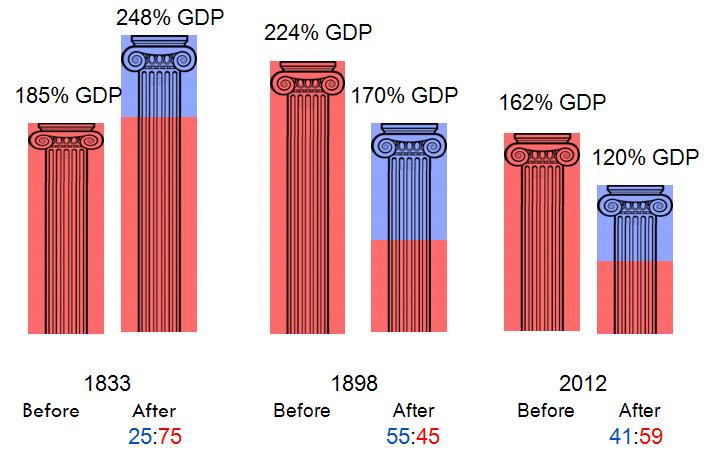
Perhaps, instead of “the product of a sick imagination,” as the Greek Education Minister defined it, the most recent German plan may be a consequence of the high degree of historical awareness in that country! If so, the history-conscious Germans should take heed of the dangers in using wrong historical analogies as a guide for policy. And this leads me to the third lesson. In 1898 Greece only accepted to surrender its fiscal sovereignty to the ICC as a counterpart to the settlement of a disastrous war and at a time when Ottoman troops still occupied the north of the country. In other words, the value of the status quo was very negative and the Greeks had no real choice but to accept the deal imposed by the guaranteeing powers. Today, the successive rounds of austerity imposed on the Greeks as counterpart for the release of outside help risk eroding the internal option of remaining within the framework of the troika negotiations.The temptation of going their own way correspondingly increases.
The Greeks might be recalled of the trials of Sisyphus and imagine themselves as being compelled to roll a heavy rock up a hill, only to watch it roll back down, and having to start again. Will they wait until eternity?
Thursday, 2 February 2012
more news from the outside
today, from the New York Times, here. It raises some relevant issues:
a) that whether we like it or not, the Portuguese debt situation cannot be seen independently from what happens to Greece
b) that despite efforts by the Portuguese Government, and some statements from EU officials, to differentiate Portugal case from the Greek case, this is harder to achieve that it is believed - as a principle, to be able to signal difference, Portugal needs to take actions that Greece would not do, and for the moment there are some such differences: political consensus about the rescue plan, labor market reforms and wage cuts in civil servants pay, are the more significant ones. But somehow they fail to make their way into the overall prospects of the country.
To be followed closely, of course, in the coming days what is the real deal with Greece.
Monday, 9 January 2012
A desvalorização fiscal mudou de poiso
Dois membros deste blogue, eu e o Francesco Franco, devotámos muita energia nos últimos 21 meses a defender que Portugal deveria ter baixado a TSU e subir o IVA, uma desvalorização fiscal com efeito neutro nas finanças públicas e com potencial para estimular a nossa economia no curto prazo e combater a recessão. Para os argumentos iniciais, podem ver a minha página ou ver as várias entradas neste blogue.
Não foi essa a opção deste governo, em parte por algumas boas razões. Mas uma crítica que me fez confusão foi que esta era uma ideia esotérica, coisa de académicos, e que Portugal não se devia por com experiências. Até alguns antigos ministros das finanças, comentadores sérios e sisudos, bradaram contra o arrojo da nossa proposta.
Estou curioso em ver a reacção destas pessoas ao anúncio que a França, que começa agora a entrar numa recessão bem mais pequena que a nossa, vai.... fazer uma desvalorização fiscal exactamente nos moldes defendidos por mim e pelo Francesco. Devem estar loucos, os franceses.
Não foi essa a opção deste governo, em parte por algumas boas razões. Mas uma crítica que me fez confusão foi que esta era uma ideia esotérica, coisa de académicos, e que Portugal não se devia por com experiências. Até alguns antigos ministros das finanças, comentadores sérios e sisudos, bradaram contra o arrojo da nossa proposta.
Estou curioso em ver a reacção destas pessoas ao anúncio que a França, que começa agora a entrar numa recessão bem mais pequena que a nossa, vai.... fazer uma desvalorização fiscal exactamente nos moldes defendidos por mim e pelo Francesco. Devem estar loucos, os franceses.
Tuesday, 20 December 2011
Second review of the IMF - December 2011
The IMF has concluded the second review, see press release
Relevant note: the drop of the fiscal devaluation is now official, but no substitute is known up to the moment.
Sunday, 18 December 2011
combate de blogs

This is a post with a different nature, the portuguese economy has been nominated in the short list to win the category of best collective blog in Portugal.
You can see all categories and nominations here.
It is always good to know that others pay attention to our efforts!
Tuesday, 13 December 2011
Smart interpretations of a Treaty and debt management
If you have followed the debate on the ECB as a lender of last resort you probably came across Article 123 of the Lisbon treaty. Article 123 prohibits the ECB from purchasing bonds directly from public bodies. Paragraph 1 says:
1. Overdraft facilities or any other type of credit facility with the European Central Bank or with the central banks of the Member States (hereinafter referred to as ‘national central banks’) in favour of Union institutions, bodies, offices or agencies, central governments, regional, local or other public authorities, other bodies governed by public law, or public undertakings of Member States shall be prohibited, as shall the purchase directly from them by the European Central Bank or national central banks of debt instruments.
However Paragraph 2 allows the ECB to purchase bonds from a public bank.
2. Paragraph 1 shall not apply to publicly owned credit institutions which, in the context of the supply of reserves by central banks, shall be given the same treatment by national central banks and the European Central Bank as private credit institutions.
(Paragraph 2 was the basis of Soros proposal to transform the ESF into a bank in order to have access to the ECB liquidity. The proposal was rejected.).
Now the key question is who qualifies as a "publicly owned credit institution" described in paragraph 2? At first sight the German Finance Agency (Finanzagentur) qualifies (any one can confirm?). Finanzagentur auctions german debt, through the Buba, using a retention mechanism. The retention mechanism, that came in the highlights with the last November Bund auction, allows Germany to use "the sale of German Government securities in the secondary market that stem from the portions set aside in the auctions" to meet borrowing requirement. According to the Corriere della Sera, the Italian treasury already expressed interest in the retention mechanism as it permits a less risky debt management (if you check the graphs below, you will notice that the last bund auction, where 40% of the bonds have been retained has commanded an average yield of 1.98% when the coupon offered was 2%). Other euro governments might want to follow as well.
(click to enlarge)


1. Overdraft facilities or any other type of credit facility with the European Central Bank or with the central banks of the Member States (hereinafter referred to as ‘national central banks’) in favour of Union institutions, bodies, offices or agencies, central governments, regional, local or other public authorities, other bodies governed by public law, or public undertakings of Member States shall be prohibited, as shall the purchase directly from them by the European Central Bank or national central banks of debt instruments.
However Paragraph 2 allows the ECB to purchase bonds from a public bank.
2. Paragraph 1 shall not apply to publicly owned credit institutions which, in the context of the supply of reserves by central banks, shall be given the same treatment by national central banks and the European Central Bank as private credit institutions.
(Paragraph 2 was the basis of Soros proposal to transform the ESF into a bank in order to have access to the ECB liquidity. The proposal was rejected.).
Now the key question is who qualifies as a "publicly owned credit institution" described in paragraph 2? At first sight the German Finance Agency (Finanzagentur) qualifies (any one can confirm?). Finanzagentur auctions german debt, through the Buba, using a retention mechanism. The retention mechanism, that came in the highlights with the last November Bund auction, allows Germany to use "the sale of German Government securities in the secondary market that stem from the portions set aside in the auctions" to meet borrowing requirement. According to the Corriere della Sera, the Italian treasury already expressed interest in the retention mechanism as it permits a less risky debt management (if you check the graphs below, you will notice that the last bund auction, where 40% of the bonds have been retained has commanded an average yield of 1.98% when the coupon offered was 2%). Other euro governments might want to follow as well.
(click to enlarge)
Webinar on European Safe Bonds (ESBies)
Tomorrow at noon (New York time. EST), 5pm Portugal time (GMT). Register here if you want to listen in or ask questions:
http://prmia.org/events/view_events.php?eventID=T4705
http://prmia.org/events/view_events.php?eventID=T4705
Friday, 9 December 2011
The European Debt Crisis: a succession of bad ideas
I recently gave a talk about the European debt crises. I focussed on the many policy blunders committed so far, as well as on the many that are still occupying the agenda. Here was my list:
Bad idea #1: You can run a monetary union and have a single currency and central bank without:
1. Fiscal backing for your central bank
2. European-wide banking regulation and deposit insurance
3. A European-wide safe asset
Subscribe to:
Posts (Atom)